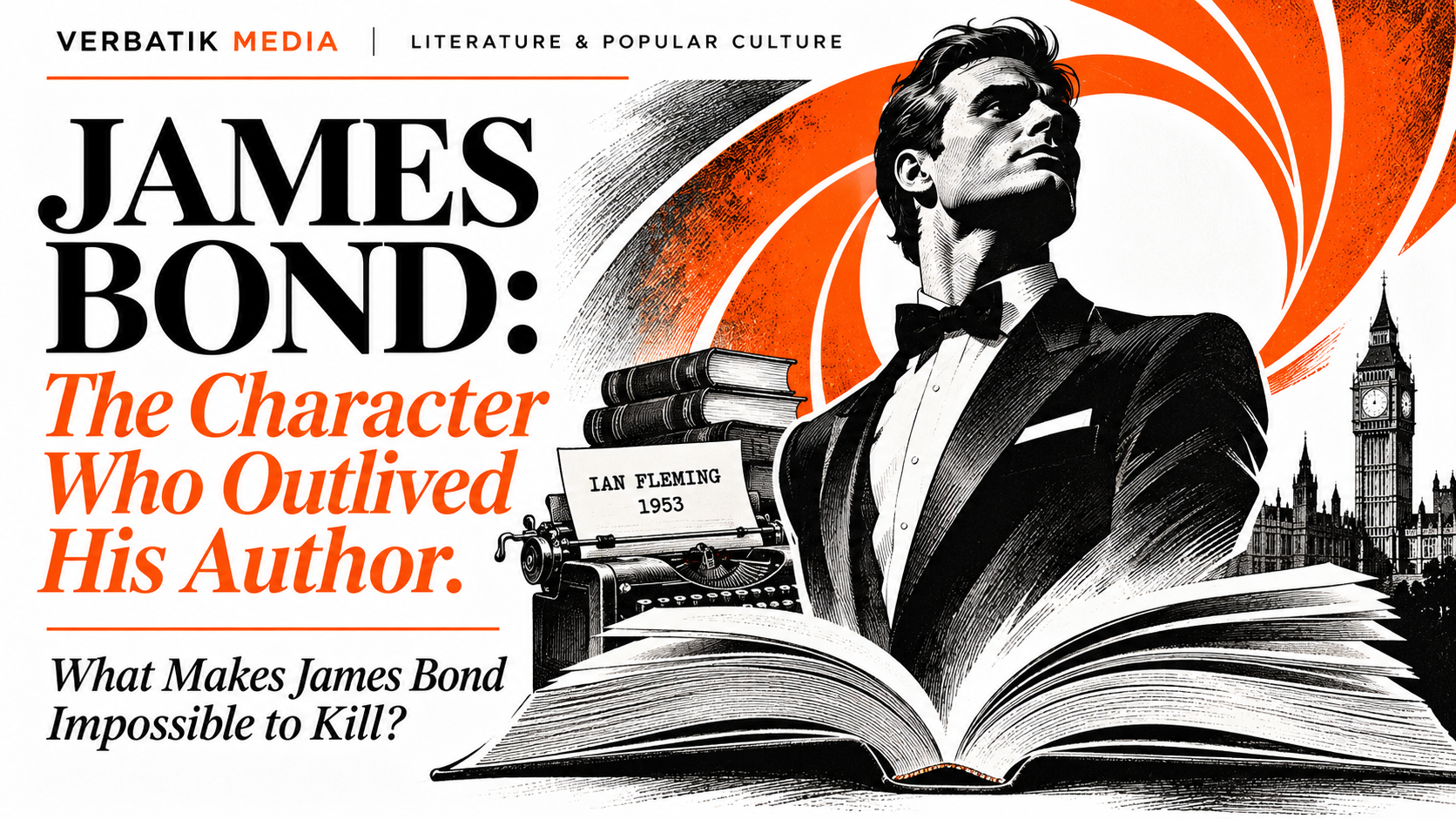
Somewhere in Jamaica, in 1952, a man sat down at a typewriter and began inventing another man. That fictional man would survive the death of his creator, the end of the Cold War, generations of changing cultural expectations, twenty-five official films and, eventually, his own cinematic death.
And now, Robert Pattinson is preparing to introduce him to another generation.
Ian Fleming’s greatest achievement wasn’t just creating a spy capable of escaping death, it was creating a character capable of surviving for decades. Fleming stopped writing more than seventy years ago but James Bond is still being brought to life on screen over and over again, and we love keep loving him more and more!
On 16 November 2026, Amazon MGM Studios officially announced Pattinson as the next 007, bringing years of speculation to an end and, rather predictably, giving the internet something new to argue about. But while everyone is busy discussing whether Robert Pattinson possesses the requisite charm, sophistication and physical presence to play James Bond, I find myself considerably more interested in the man who created the legend. Ian Fleming.
Because in 1953, Fleming created a fictional character so remarkably enduring that seventy-three years later, the world is still arguing about what he should look like. And here’s where things become particularly interesting.
Spoiler alert for No Time to Die (2021).
James Bond died on screen in 2021 and his creator, Ian Fleming, died in 1964. And yet, here we are, discussing the character’s next incarnation as though death were merely an afterthought.
As an author and developmental editor, I find this absolutely fascinating. What exactly did Fleming create? And why are so few fictional characters capable of accomplishing the same thing?
In February 1952, at his Jamaican home, GoldenEye, Ian Fleming began writing his first James Bond novel. Published the following year, Casino Royale introduced readers to a British secret agent tasked with financially destroying a Soviet-backed enemy operative at a French casino.
What followed was considerably more than an entertaining espionage story. Fleming would eventually produce twelve Bond novels and two short-story collections, establishing the foundations of what would become one of the most recognisable fictional franchises in the world.
But the original literary Bond was not quite the man many of us associate with the films. He could be ruthless, cynical, emotionally exhausted and, despite his considerable professional competence, remarkably vulnerable.
His relationship with Vesper Lynd in Casino Royale is particularly revealing. A man accustomed to professional detachment finds himself contemplating marriage, only to have that possibility destroyed by betrayal and tragedy.
Interestingly, the emotional consequences of this experience help shape the very detachment that becomes synonymous with him.
Fleming understood something extremely important and fundamental about character creation: exceptional competence becomes considerably more interesting when accompanied by emotional frailty. For example, Bond could save the world but he was considerably less successful at protecting himself from it.

What Makes James Bond Impossible to Kill?
Strip James Bond of his Aston Martin, replace his expensive suit with an ordinary jacket, confiscate his gadgets and, heaven forbid, give him a glass of water instead of a martini.
Would he still be James Bond?
I’d argue that he would. Because although these elements contribute to Bond’s recognisability, they are not the foundation of his identity.
In examining enduring fictional characters, I find it useful to distinguish between what we might call a character’s external identifiers and their Character DNA. External identifiers are the visible attributes through which audiences recognise a character. Character DNA, on the other hand, is the underlying combination of psychological, behavioural and narrative characteristics that makes that individual distinctive.
In Bond’s case, five elements stand out.
- Competence: His extraordinary ability to function under pressure, often when the circumstances appear impossible.
- Contradiction: The coexistence of refinement and brutality, elegance and violence, pleasure and professional sacrifice.
- Vulnerability: The psychological and emotional consequences of a life that demands detachment.
- Agency: His willingness to make consequential decisions, even when they conflict with instructions or personal interests.
- Narrative identity: His relationship with danger, espionage, institutional loyalty and the moral ambiguities of his profession.
What makes these qualities especially compelling is the tension between them. Bond’s loyalty clashes with his independence, his professional competence with his emotional vulnerability, and his sophistication with his capacity for brutality. These contradictions generate the very conflicts that keep his stories interesting. As we’ve explored in our discussion of conflict, story beats and character archetypes, character development becomes considerably more effective when personality and narrative conflict are allowed to influence one another.
These elements are considerably more important than the colour of his hair. And this is where many writers encounter difficulties in character development. They invest considerable effort in establishing what their protagonist looks like, what they wear, what they enjoy eating and how they take their coffee, without sufficiently exploring how that protagonist thinks, chooses and responds to conflict.
Physical details certainly have their place, as we’ve discussed in one of our articles on techniques for developing memorable characters. But an interesting collection of personality traits does not automatically constitute an interesting personality.
A character’s clothes and accessories make them recognisable, but it’s their contradictions that make them fascinating and their choices that make them unforgettable.

The Art of Changing a Character Without Losing Him
One of the most remarkable things about James Bond is that the character has survived interpretations that are dramatically different from one another.
Sean Connery’s Bond combined physical confidence with an unmistakable sense of danger. Roger Moore leaned considerably more towards humour and theatrical sophistication. Timothy Dalton brought severity and intensity to the role, while Daniel Craig’s interpretation explored vulnerability, emotional consequences and the physical cost of being Bond.
What distinguishes Craig’s Bond is not merely that his adventures become physically more dangerous, but that the consequences increasingly become personal. His relationships, loyalties and emotional responses acquire greater narrative importance. This is a useful example of the distinction between plot movement and emotional movement: events may propel a story forwards, but their effect on the character determines much of their emotional significance.
These men did not simply deliver the same character in different suits. They emphasised different possibilities within the same character. And audiences continued to recognise him.
In his academic study, Containing the Spectre of the Past: The Evolution of the James Bond Franchise During the Daniel Craig Era, film scholar Jonathan Murray examines the franchise’s relationship with its established identity during a period of significant reinvention.
This tension between familiarity and novelty is particularly interesting from a storytelling perspective. A character who cannot evolve risks becoming a caricature of themselves. But a character who changes beyond recognition risks losing the very qualities that made audiences care in the first place.
Bond’s longevity also raises difficult questions about the values embedded in his original conception. Fleming’s portrayal of women, race and British power reflects aspects of the cultural environment in which he wrote.
Preserving a character’s identity does not necessarily require preserving every prejudice or convention associated with their original creation.
I believe, the extraordinary thing about Bond is not that he has remained unchanged for seven decades. It’s that he hasn’t needed to.
The literary life of James Bond did not end with Ian Fleming’s death. In 1968, Kingsley Amis, writing under the pseudonym Robert Markham, published Colonel Sun, the first official Bond continuation novel. Decades later, Anthony Horowitz would write Forever and a Day, a prequel to the very novel that introduced Bond to the world. Other writers have continued to expand his literary universe, with the character appearing in novels, comics, short fiction and numerous adaptations.
Bond belongs to a particularly fascinating category of fictional characters. Think of Sherlock Holmes, Dracula or Batman. Their original creators established personalities and narrative possibilities so distinctive that subsequent storytellers have repeatedly found new ways to explore them.
Of course, literary immortality is not exclusively a consequence of exceptional characterisation. Commercial investment, intellectual property management, distribution and cultural exposure all contribute to the continued existence of these franchises.
Nevertheless, there is something extraordinary about a fictional individual who can be removed from their original story and placed within another without immediately becoming redundant. Their existence is no longer dependent on a single plot. They can generate stories of their own. And that, I believe, is one of the most interesting achievements in character creation.
What Every Writer Can Learn from James Bond
When developing a protagonist, writers often begin with the story they want to tell. They then create a character capable of performing the actions necessary to move that story towards its conclusion.
There is nothing inherently wrong with this approach. But consider approaching character development from the opposite direction. What kind of person have you created? What conflicts would they naturally generate? What decisions would they make that another character, placed in precisely the same circumstances, would not?
In my work as a developmental editor, I find these questions considerably more revealing than simply establishing a character’s appearance, occupation or backstory. If you’re currently developing a fictional character, consider asking yourself four questions:
- If I removed their physical description and signature possessions, would their behaviour still distinguish them?
- What fundamental contradictions make them psychologically interesting?
- Could this character generate a compelling story outside the plot I’ve currently written?
- What could change about them without destroying their essential identity?
These questions can add considerable depth to a conventional character profile, taking the exercise beyond biographical details and towards an understanding of the character as a psychologically distinctive individual.
Try it with your own protagonist: If you’d like to explore these questions beyond the article, download our free Building Memorable Characters Workbook. It includes exercises designed to help writers develop characters with greater psychological and emotional depth.
Not every fictional character needs to become James Bond, of course. Some of the most extraordinary literary characters belong to a single story, and their power comes precisely from the fact that their journey has a definitive ending. But every writer can learn something from creating characters who feel capable of existing beyond the boundaries of the plot.Characters who seem to have lived before the first chapter and might continue living after the last.
Frequently Asked Questions:
Who created James Bond, and when did he first appear?
British author Ian Fleming created James Bond, introducing the fictional secret agent in his debut novel, Casino Royale, published in 1953. Fleming subsequently wrote twelve Bond novels and two short-story collections.
Why has James Bond remained popular for so many decades?
James Bond’s enduring popularity can be attributed to his distinctive characterisation, recognisable narrative identity, adaptability across generations and extensive cultural and commercial presence. His cinematic and literary reinventions have allowed him to evolve while retaining familiar characteristics.
Who is the next James Bond after Daniel Craig?
Robert Pattinson was officially announced as the next James Bond by Amazon MGM Studios on 16 November 2026, becoming the seventh actor cast in the leading role of the official Bond film series.



Leave a Reply