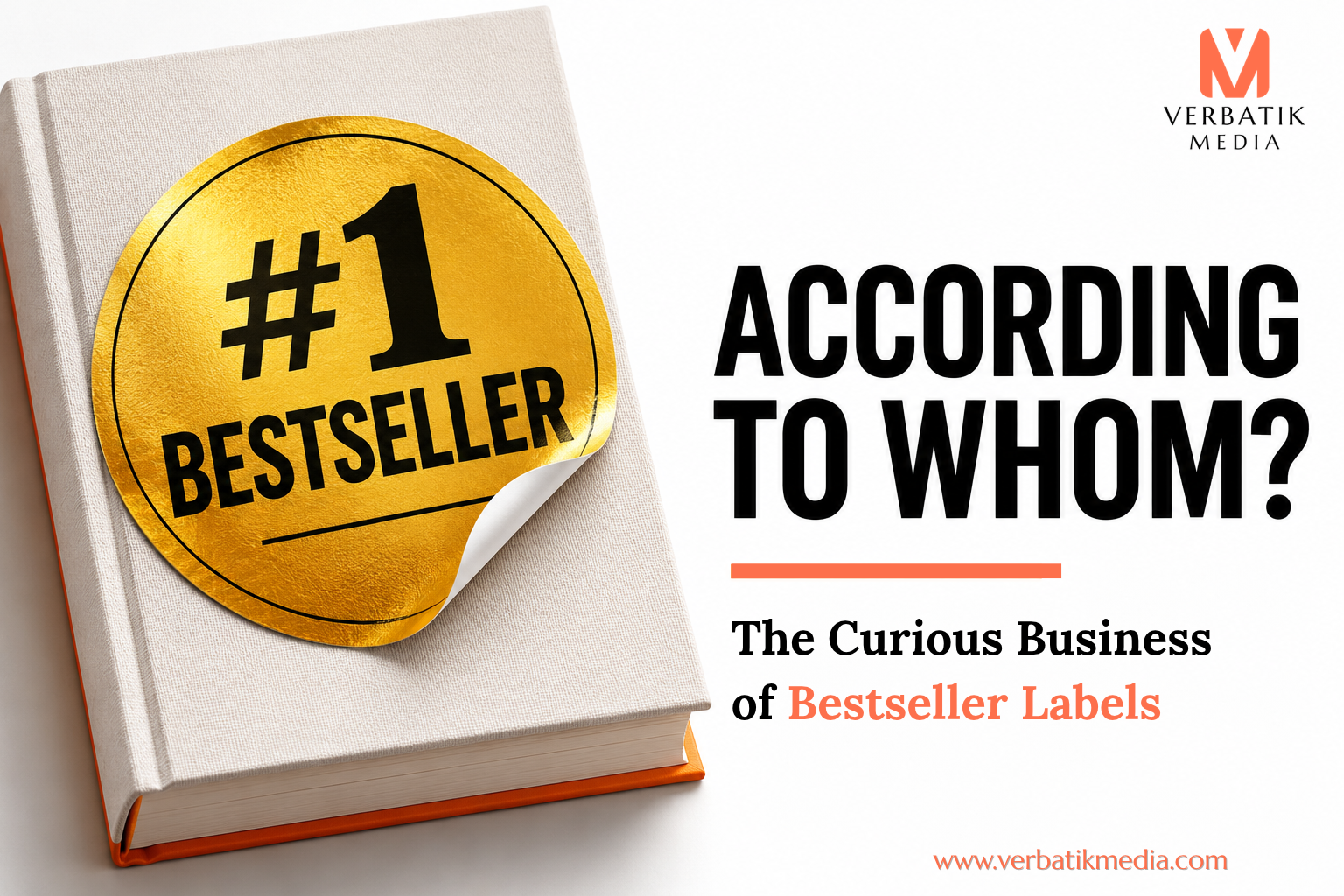
Everyone’s a bestselling author these days.
Or so it would seem.
Open Instagram, scroll through LinkedIn, browse a bookshop, or spend five minutes on Amazon, and you will encounter an impressive number of authors proudly announcing their bestselling status. Some are national bestsellers. Others are international bestsellers. Several are Amazon #1 bestselling authors. A few have apparently managed the extraordinary feat of becoming bestsellers before their books have even had much of a chance to be read.
At this rate, one begins to wonder whether there are any books left that aren’t bestsellers.
Now, there is nothing inherently wrong with celebrating commercial success. Writing a book is difficult. Publishing one is harder than most people realise. Convincing strangers to spend their money on it is an achievement worth celebrating.
But somewhere between the Amazon rankings, the promotional campaigns, the shiny gold stickers, and the increasingly enthusiastic author biographies, the word bestseller seems to have acquired a rather elastic definition.
And I find myself returning to one question:
Bestselling according to whom, exactly?
Because, as it turns out, the answer is considerably more complicated than most readers—and perhaps even some authors—realise.
The Bestseller Is Not a Universal Standard
When we hear that a book is a bestseller, our minds generally produce a fairly straightforward picture: thousands upon thousands of copies flying off shelves, enormous reader interest, widespread recognition, and perhaps a publisher somewhere opening a celebratory bottle of champagne.
That picture isn’t necessarily wrong.
It simply isn’t the only possible picture.
There is no single, universally accepted sales threshold that automatically transforms a book into a bestseller. The designation depends on who is measuring sales, which books are being compared, where they are being sold, and over what period.
A book might be the highest-selling title in a particular Amazon subcategory. Another might dominate sales across several major retailers. A third might appear on a nationally recognised bestseller list, while a fourth might sell consistently for years without ever occupying its top position.
All four could be commercially successful. Yet their achievements represent very different things.

This is the first distinction worth understanding: a bestseller is a ranking, not necessarily a sales milestone. And rankings, by their very nature, require context. Publishing, unfortunately, doesn’t always trouble itself with such distinctions.
The Curious Case of the Amazon Bestseller
Perhaps nowhere is the flexibility of the bestseller designation more apparent than on Amazon.
To understand why, we need to look at something called the Amazon Best Sellers Rank, or BSR.
Amazon assigns books sales rankings based on customer activity relative to other books. Rankings take recent and historical activity into account, with recent activity carrying greater weight. They fluctuate as competing titles experience changes in demand.
Amazon’s own documentation makes an important point: a book’s ranking can rise or fall even when its own customer activity remains unchanged, simply because other books are performing differently.
In other words, a ranking does not exist in isolation. It is a constantly moving comparison.
Then there are the categories.
A book may appear under several classifications, and its performance in a relatively specialised category can be substantially different from its position in a broader one. A title might rank first within a particular niche while occupying a far less remarkable position among books overall.

Which is the bigger commercial success?
Without knowing the actual sales figures, market coverage, and period being measured, we cannot say with certainty.
And yet, only one of those authors might be announcing a new number-one ranking on Instagram that afternoon.
This is not to suggest that Amazon bestseller rankings are meaningless. They offer useful information about relative demand within the platform. They can be particularly valuable for independent authors attempting to understand how their books perform in specific categories.
But they are not comprehensive measures of national sales, nor do they reveal precisely how many copies a book has sold.
There is another detail worth remembering: Amazon maintains distinctions between formats and between free and paid Kindle rankings. Reaching a prominent position during a free ebook promotion is not the same as reaching that position through paid purchases.
The distinction matters.
After all, there is a considerable difference between readers deciding to download something offered at no cost and readers deciding to pay for it.
Both can indicate interest. Only one directly represents a paid purchase.
So, the next time you encounter an Amazon #1 bestseller, you might reasonably ask: Number one in which category, on which marketplace, in which format, and when?
Suddenly, the claim becomes rather more informative.
Not All Bestseller Lists Are Created Equal
Amazon is hardly the only organisation compiling bestseller rankings.
The New York Times bestseller lists are among the most recognisable in publishing, but their methodology differs substantially from Amazon’s category-based rankings.
The Times compiles its lists using sales information reported by a network of booksellers and other vendors in the United States. Its methodology involves statistical weighting, eligibility rules, and scrutiny of certain purchasing patterns, including bulk orders.
Consequently, appearing on a New York Times bestseller list represents a different achievement from reaching #1 in an Amazon category.
Neither designation, incidentally, tells us everything about a book’s performance.
The New York Times does not track every possible type of book, and its lists do not represent a complete accounting of every book sold throughout the country. Amazon, meanwhile, measures activity within its own retail ecosystem.
Then there is NielsenIQ BookScan, which tracks print-book sales through participating retailers across multiple international markets, including India. Its point-of-sale data helps publishers and industry professionals understand purchasing patterns, market share, and the commercial performance of individual titles.
This is particularly relevant in India, where discussions about bestselling books frequently revolve around online rankings and promotional claims.
India has a diverse book market spanning major retail chains, independent booksellers, online platforms, regional-language publishing, educational markets, and numerous distribution channels. No single ranking automatically captures all of these.
A book performing exceptionally well on Amazon India might not be the highest-selling book across the wider Indian market. Equally, a title enjoying sustained sales through physical retailers might attract relatively little attention on Amazon’s category charts.
Neither situation is contradictory.
They are simply different measurements of success.
The problem begins when we treat them as interchangeable.
When a Ranking Becomes a Marketing Strategy
Here is where things become particularly interesting.
A bestseller ranking is not merely an outcome authors hope to achieve. Increasingly, it can also become an objective around which a book launch is organised.
And from a marketing perspective, that makes perfect sense.
A book carrying a bestseller designation immediately acquires an additional layer of perceived credibility. It becomes easier to promote, easier to distinguish from competing titles, and potentially more attractive to readers who are unfamiliar with the author.
Authors and publishers may therefore coordinate promotional campaigns, advance publicity, mailing-list announcements, launch-day offers, and advertising to concentrate purchases within a particular period.
These are legitimate marketing practices.
There is nothing objectionable about encouraging readers to purchase a book during its launch week. Nor is there anything inherently dishonest about selecting appropriate categories in which a book has a realistic chance of performing well.
The difficulty arises when a specific achievement is presented as something much broader.

A book briefly reaching the top of a narrowly defined category is not necessarily evidence of extraordinary national demand. A title performing strongly during a promotional window has not automatically demonstrated sustained commercial success.
And yet, once the screenshot has been taken, the surrounding context has an unfortunate habit of disappearing.
The category disappears.
The marketplace disappears.
The period disappears.
What remains is the rather handsome phrase: #1 Bestselling Author.
It may be technically grounded in a genuine ranking. But without qualification, readers can reasonably interpret it as a much broader claim.
That is a marketing problem, certainly, but it is also a question of transparency.
There is an important distinction between celebrating a legitimate ranking and deliberately manufacturing a misleading impression of success.
The former is commendable. The latter deserves scrutiny.
And to be clear, neither traditional publishers nor independent authors are immune to the temptation. The incentive to make a book appear successful exists wherever perceived popularity helps sell more copies.
The Psychology of the Bestseller Sticker
Why does the designation matter so much in the first place?
Because readers, like everyone else, rely on shortcuts when making decisions.
Consider an ordinary visit to a bookshop.
You are standing before shelves containing hundreds of titles. You cannot read them all. You may not recognise most of the authors. You have limited time, limited money, and an overwhelming number of choices.
Then you notice a gold sticker announcing that one particular book is a bestseller.

Immediately, it seems a little more reassuring.
Other people have apparently bought it. Enough people, presumably, to make it noteworthy. Perhaps there is something here worth discovering.
This is a familiar psychological phenomenon known as social proof: the tendency to use other people’s behaviour as a guide when making our own decisions.
In publishing, bestseller labels function as powerful social signals.
They can suggest popularity, relevance, legitimacy, and sometimes even quality, although those qualities are not necessarily connected.
The effect can also become self-reinforcing.
A book receives attention because it is selling. That attention encourages further purchases. Those purchases improve its visibility, attracting still more attention.
Success becomes part of the mechanism producing further success.
There is nothing particularly mysterious about this. Publishing has always relied on reputation, publicity, recommendations, reviews, awards, and other signals to help readers navigate an enormous marketplace.
The bestseller label is simply one of its most efficient tools.
What concerns me is not that readers respond to such labels, but that we rarely encourage them to ask what those labels actually represent.
A book being popular tells us that people have bought it.
It does not tell us why they bought it.
And it certainly doesn’t tell us what they thought after finishing it.
A Bestseller Is Not Necessarily a Good Book
This is where I must put on my editor’s hat.
As someone who spends a considerable amount of time examining manuscripts, studying narrative structures, untangling plots, and questioning character motivations, I find the tendency to equate commercial success with literary excellence particularly fascinating.
Because the two are not synonymous.
A book can be brilliantly written, structurally sophisticated, emotionally devastating, and almost entirely overlooked by the commercial market.
Another can possess obvious narrative weaknesses, predictable character arcs, awkward prose, or substantial editorial shortcomings and still sell extraordinarily well.

Sometimes, of course, a book manages both: remarkable craftsmanship and remarkable commercial success.
But bestseller status cannot establish literary merit any more than literary merit can guarantee sales.
The factors contributing to a book’s commercial performance are numerous: timing, genre expectations, publicity, distribution, author recognition, cultural relevance, pricing, accessibility, reader communities, and sheer visibility.
Good writing matters. So does good storytelling.
But a well-written book is not automatically a well-marketed book, and a well-marketed book is not automatically well-written.
As an editor, I have encountered manuscripts that possess tremendous literary promise but would struggle commercially without clearer positioning or a stronger understanding of their intended readership.
I have also seen how an accessible premise, compelling hook, or timely subject can generate considerable interest in a book whose execution is less accomplished than its marketing.
Neither observation diminishes the value of readers’ preferences.
Literature does not exist solely to satisfy editorial standards. Readers seek different things from books: entertainment, companionship, reassurance, intellectual stimulation, emotional escape, recognition, or simply a good story told without unnecessary complication.
A book need not be a masterpiece to provide those things.
But we should be careful not to confuse market validation with an objective verdict on craftsmanship.
Bestselling is a commercial distinction. Literary excellence is an entirely different conversation.
And, frankly, it would be refreshing if we allowed the two conversations to coexist without insisting that one must prove the other.
So, How Many Copies Does a Book Need to Sell to Become a Bestseller?
This is perhaps the most revealing question of all.
And the answer is: it depends.
There is no universal number.
A ranking is determined by the methodology and competitive environment of the particular list. A specialised retailer category can have a very different level of demand from a broad national sales chart.
The number of purchases required to reach a particular position may also change considerably over time.
A quiet week, a particularly competitive release season, a major celebrity launch, or a surge in demand within a specific genre can all affect what it takes to reach the top.
For Amazon, the precise number of copies sold by competing titles is generally not disclosed through the public rankings.
For other bestseller lists, additional eligibility criteria and reporting methods may influence which titles qualify and how they are positioned.
Therefore, anyone promising that selling a fixed number of books will automatically make an author a bestseller should be asked a fairly basic follow-up question.
On which list?
Without that information, the promise is incomplete.
And perhaps that is the real lesson behind the curious mathematics of bestseller status: a number-one ranking sounds absolute, but its meaning is almost always relative.
What Should Readers and Authors Actually Look For?
For readers, I would suggest approaching bestseller claims with curiosity rather than suspicion.
There is no need to dismiss a book simply because its cover announces a commercial achievement. But neither should that announcement substitute for your own judgement.
Look at the premise. Read the opening pages. Consider reviews that discuss the book’s substance rather than merely praising its popularity. Pay attention to whether the writing, subject, and storytelling genuinely interest you.
For authors, my suggestion is even simpler.
Celebrate your achievements. Absolutely.
If your book reaches #1 in a specific category, say so. If it appears on a recognised national bestseller list, name that list. If it sells an extraordinary number of copies, share those figures when they can be substantiated.
Specificity does not diminish success.
It gives success credibility.
A claim such as #1 in Amazon India’s Kindle category for Contemporary Romance may lack the dramatic brevity of International Bestselling Author, but it communicates an actual, identifiable achievement.
And credibility, unlike a temporary ranking, is something worth protecting over the long term.
The Book Beyond the Badge
I do not believe bestseller labels are inherently deceptive, nor do I think authors should be embarrassed by their commercial ambitions.
Books are cultural objects, certainly, but they are also products within an industry. Their creators deserve recognition, financial reward, and the opportunity to reach as many readers as possible.
There is nothing unliterary about wanting a book to sell.
What troubles me is the ease with which a precise commercial measurement can be transformed into an ambiguous declaration of importance.
A bestseller label can tell us something meaningful about a book’s performance. It cannot tell us everything about its reach, its quality, or its significance.
A ranking can capture a moment of commercial success.
It cannot measure the quiet experience of someone reading a novel ten years after its release and finding something in it that changes the way they understand themselves.
It cannot measure the story that stays with a reader for decades, the book passed between generations, or the passage someone returns to during a particularly difficult period of life.
Those things rarely appear on sales charts.
And yet, surely, they matter.
Perhaps the more interesting question isn’t whether a book was a bestseller, but whether it was worth reading after the sticker came off.
Frequently Asked Questions (FAQs)
1. How many copies does a book need to sell to become a bestseller?
There is no universally accepted number of copies a book must sell to qualify as a bestseller. The threshold depends on the retailer, bestseller list, genre, category, and period being measured. A book might reach #1 in a relatively small Amazon category with comparatively modest sales, while appearing on a major national bestseller list could require substantially greater sales across participating retailers. Bestseller status is therefore a relative ranking rather than a fixed sales milestone.
2. What does being a #1 Amazon bestseller actually mean?
A #1 Amazon bestseller is a book that has reached the top position on a particular Amazon bestseller ranking, which may be within a specific category, format, or marketplace. Amazon’s Best Sellers Rank (BSR) reflects a book’s relative sales performance, considering both recent and historical customer activity. Importantly, being #1 in a niche category does not necessarily mean a book is the bestselling title across Amazon or the wider publishing market. The category, marketplace, format, and timing provide essential context.
3. Is an Amazon bestseller the same as a New York Times bestseller?
No. Amazon bestseller rankings and the New York Times bestseller lists use different methodologies. Amazon rankings are generated from activity within its retail platform and can fluctuate frequently, including within individual book categories. The New York Times compiles its lists using reported sales from a network of booksellers and vendors, alongside its own eligibility rules and statistical methods. Both designations can represent genuine commercial achievements, but they measure different aspects of book sales and should not be treated as interchangeable.


Leave a Reply