
One of the reasons self-publishing became so attractive in the first place was speed.
An independent author could finish a manuscript, prepare the files, upload the book and begin selling it without waiting for acquisition meetings, seasonal publishing lists or production schedules that stretched months into the future. That flexibility changed publishing in a very real way, especially for authors who wanted more control over their timelines, pricing and backlists.
Amazon has now tightened one part of that process.
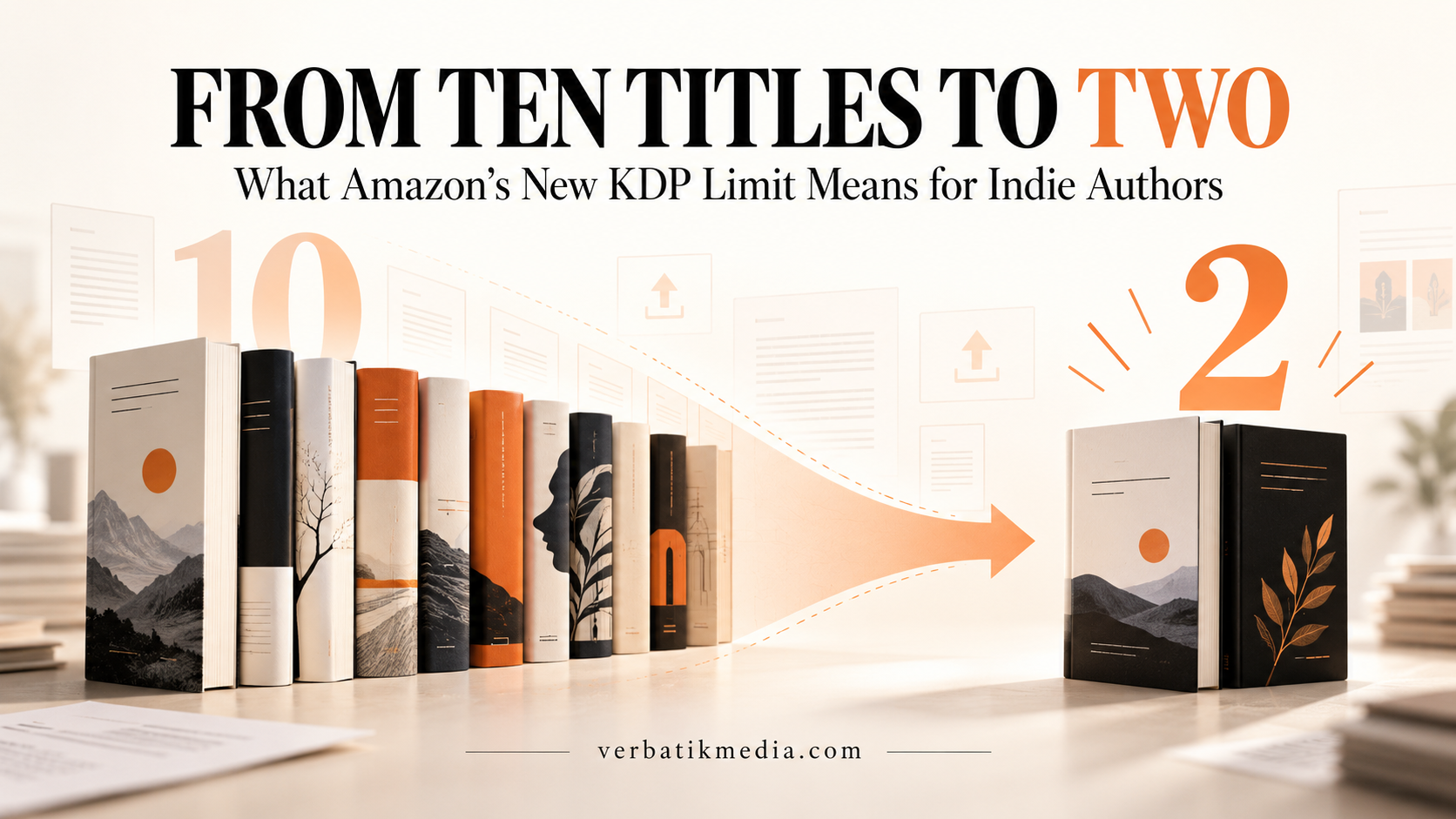
Beginning on 21 September 2026, Kindle Direct Publishing reduced the number of new titles that can be created from ten per book format each week to two per format per week. Amazon’s current KDP help pages state that publishers can now create two new titles per book format every week. In practical terms, that means two Kindle eBooks, two paperbacks and two hardcovers within the same weekly cycle.
At first glance, this sounds like a small technical change.
For most authors, it probably is.
But I think it is worth paying attention to, because changes like this often tell us something about the direction a platform is moving in long before the larger effects become obvious.
What has actually changed?
The first thing to understand is that Amazon is limiting new title creation, not the total number of books an author can have on KDP.
If you already have twenty, fifty or even two hundred books published, those titles are not affected. The restriction applies only when you create new titles.
The previous ceiling was ten titles per format per week. It is now two.
The phrase per format is important here.
If you are publishing one book simultaneously as an eBook, paperback and hardcover, you are using one slot in each format category. So an author could still, in theory, create two complete multi-format books within the same week.
For the average novelist or non-fiction writer publishing a few books a year, this is unlikely to create any real inconvenience.
In my experience, most serious authors are nowhere near producing two completely new books every week. Even rapid-release writers tend to work on schedules measured in weeks or months rather than days.
Where the change becomes more interesting is for publishers or authors working at scale.
That includes people uploading large backlists, releasing multiple translations, producing low-content books, managing several pen names or building high-volume catalogues.
And this is where I think the larger conversation begins.
This probably tells us more about volume than about ordinary authors
Self-publishing has created some genuinely exciting publishing models.
I have seen authors build entire careers around series publishing, rights reversion, re-releasing older books, creating new editions and reaching readers directly without relying on a traditional publisher.
That freedom is one of the strongest things about independent publishing.
But over the past few years, the amount of content that can be produced quickly has increased enormously.
Generative AI has accelerated that even further. Text, illustrations, translations, covers and metadata can now be created at a speed that would have been impossible only a few years ago.
Amazon already requires publishers using KDP to disclose AI-generated text, images or translations, while distinguishing this from AI-assisted work such as brainstorming or editing.
What Amazon has not said is that this new two-title limit exists specifically to control AI-generated books.
So I would be careful about making that claim.
Still, it is difficult to ignore the wider environment in which this change is happening. When platforms are receiving more content, produced more quickly and in larger quantities, they eventually have to find ways to control the flow.
A weekly title limit is a very simple way of doing that.
It does not solve questions around originality, copyright or quality. It does not tell us whether a book is good, useful or even responsibly produced.
What it does is slow things down.
And sometimes slowing things down is exactly what a platform needs when the volume of incoming content becomes difficult to manage.
For most serious indie authors, this may not be bad news at all
I can understand why any new restriction from Amazon immediately makes independent authors nervous.
The platform is already central to so many publishing businesses that even a small policy change can feel much larger than it is.
But if you publish thoughtfully, work with proper production timelines and release books at a normal pace, this limit is unlikely to interfere with your work.
In fact, I can see a possible upside.
One of the problems I have noticed in self-publishing over the years is that the conversation sometimes becomes too focused on output.
Publish more.
Release faster.
Build a bigger backlist.
Keep producing.
There is nothing inherently wrong with having a large catalogue. Plenty of successful authors do.
But volume is not the same thing as publishing well.
A strong book still needs editing, positioning, cover design, metadata, proofreading, formatting and a proper launch plan. These things take time.
If tighter limits make extremely high-volume publishing a little more difficult, I do not necessarily think that is harmful to authors who are already approaching their books professionally.
It may even encourage a healthier distinction between simply uploading books and actually publishing them.
Where authors will need to plan more carefully
The people most likely to notice the restriction are those handling several releases at once.
Imagine a publisher moving a large backlist onto KDP.
Or an author launching translated editions in multiple languages.
Or someone preparing revised editions of several older books.
Those workflows now need to be scheduled with a little more care.
This is especially relevant because some changes to a book may require creating a new edition rather than simply updating an existing listing.
That means KDP setup itself should become part of the publishing calendar.
I already encourage authors to think this way with ISBNs, metadata, print files, cover files and launch dates. This new restriction simply gives us one more reason not to leave everything until publication week.
If you know several books or editions need to go live within the same month, create a schedule for them in a.dvance.
It sounds basic, but so many publishing problems happen because production decisions are left until the very end.
The larger lesson is not really about the number two
For me, the more useful takeaway is what this says about relying too heavily on one platform.
Amazon is incredibly important to independent publishing. For many authors, KDP is still the easiest and most commercially significant way to reach readers.
But Amazon is also a platform, and platforms change.
Royalty structures change.
Metadata requirements change.
Content policies change.
Upload rules change.
Discoverability changes.
Earlier this year, Amazon also changed the upper price threshold for the 70 per cent Kindle royalty option on Amazon.com, another reminder that even long-standing KDP rules are not permanent.
I see this regularly with authors who think of Amazon as the publishing business itself rather than one part of the publishing business.
There is a difference.
Your books, your files, your ISBN strategy, your website, your mailing list, your reader relationships and your publishing identity should not exist entirely inside somebody else’s platform.
KDP can be a major distribution channel.
It should not be the only thing holding your publishing career together.
So what should indie authors do now?
For most authors, nothing dramatic.
If you publish a handful of books a year, continue as normal.
If you manage a larger catalogue, start planning title creation more carefully and give yourself more lead time around releases.
If you are launching multiple editions or translations, map them out before you reach the upload stage.
And, more broadly, use this as a reminder to build a publishing process that does not depend on one platform staying exactly the same forever.
I have always believed that self-publishing works best when authors stop thinking of themselves as people uploading books and start thinking like publishers.
That means planning ahead, protecting quality, understanding distribution and building assets that belong to you.
Amazon’s new limit may barely affect the average indie author in practical terms.
But it does point towards something worth watching.
The self-publishing space is becoming more crowded, more automated and more tightly managed.
And the authors who will be best placed to navigate that are the ones who are already publishing with intention rather than simply publishing at speed.


Leave a Reply