
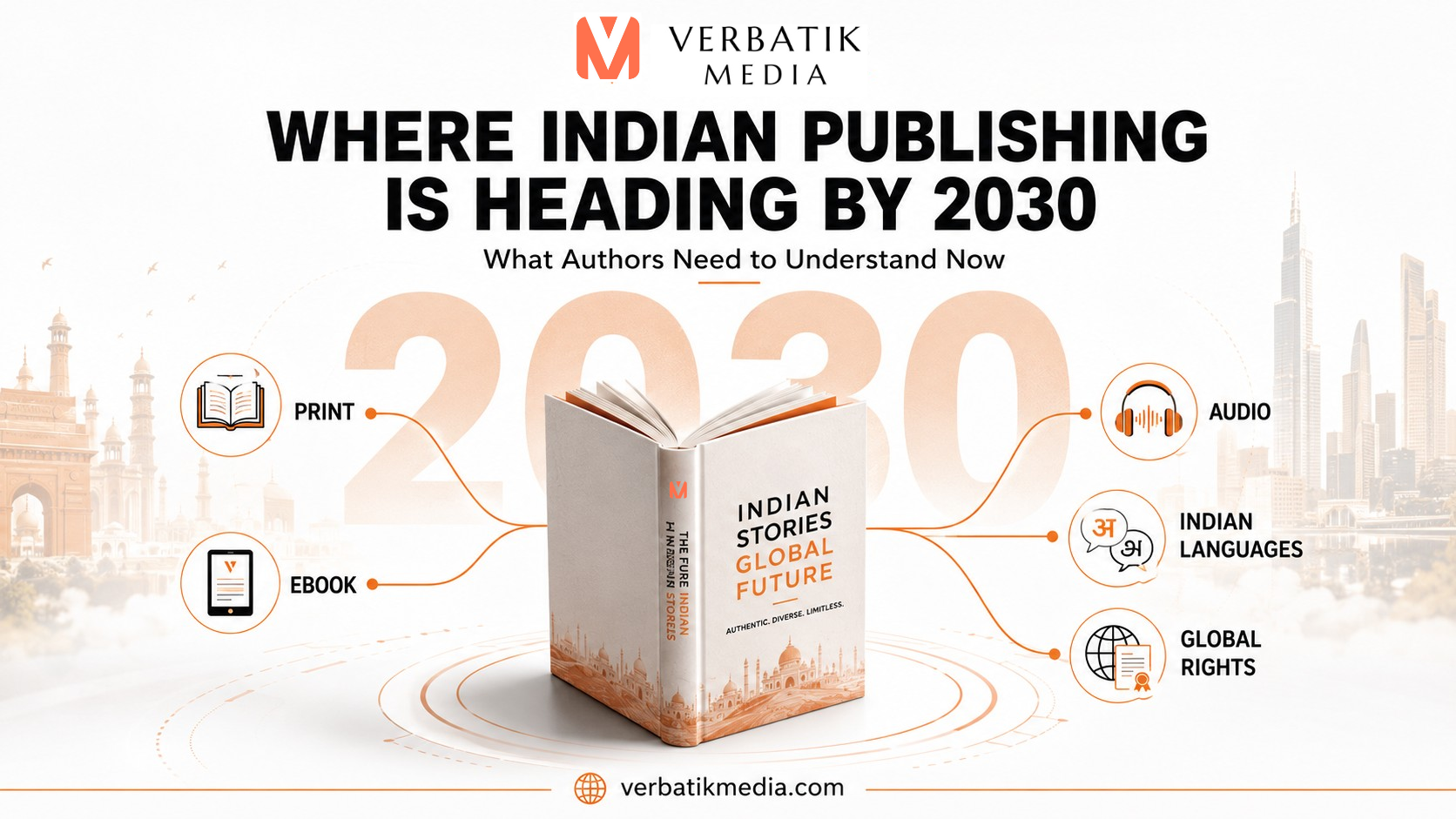
Indian publishing is entering an interesting decade.
For years, writers trying to understand the industry have largely asked the same questions: Should I approach a traditional publisher or self-publish? Should I publish in print or as an ebook? Should I concentrate on Amazon or try to get into bookstores? Should I write in English or an Indian language?
Now these very questions are no longer sufficient.
The new India Book Market Report 2026–2030, developed by the Federation of Indian Publishers (FIP) in collaboration with NielsenIQ BookData, is attempting to map a considerably larger publishing ecosystem: print, digital and audio publishing; education and trade books; copyright and licensing; technology and artificial intelligence; emerging distribution models; Indian-language publishing; employment; policy; exports; and India’s evolving position within global publishing.
That breadth is significant.
Publishing in India is no longer simply a conversation about getting a manuscript printed and placed in a bookstore. It is increasingly becoming a conversation about formats, intellectual property, languages, rights, platforms, distribution and discoverability.
For authors hoping to publish between now and 2030, understanding those changes may become almost as important as deciding how the book itself will be published.
First, It Is Worth Understanding How Large the Indian Book Market Actually Is

India is routinely described as one of the world’s major publishing markets, although headline figures can sometimes create a misleading impression for trade authors.
The earlier India Book Market Report 2022, produced by Nielsen BookData and FIP, projected India’s print book market to reach almost ₹1 lakh crore by 2024–25. The International Publishers Association described the projected market as just under US$12 billion. Read the International Publishers Association’s overview of the 2022 India Book Market Report
The Government of India’s draft National Book Promotion Policy, which cites the 2022 Nielsen/FIP research, goes further. Its projections place the total print-book publishing market at approximately ₹1,18,240 crore for 2025–26. Read the Government of India’s draft National Book Promotion Policy and market projections
That sounds extraordinary, and it is, but there is an important distinction authors should understand.
The overwhelming majority of that market is associated with education.
The same projections estimate the school-book market at approximately ₹81,610 crore for 2025–26 and higher education at around ₹32,790 crore, while the trade-book segment is projected at roughly ₹3,830 crore.
In other words, when an aspiring novelist hears that Indian publishing is a market worth more than ₹1 lakh crore, it would be a mistake to imagine that this represents the addressable market for fiction, memoir, self-help or general non-fiction.
It does, however, tell us something extremely important: books remain a very large part of India’s educational, cultural and commercial infrastructure, and the ecosystem around those books is expanding.
The question for authors is where that growth is likely to occur.
1. Print Is Not Disappearing, But the “Book” Is Becoming Multi-Format

Every few years, somebody predicts the death of the printed book.
It has proved remarkably resistant to dying.
The 2026–2030 report itself is evidence of this. NielsenIQ BookData is measuring print alongside digital and audio, rather than treating digital publishing as a replacement for physical publishing. FIP and NielsenIQ describe the project as an integrated measurement of India’s publishing economy across all three formats. See NielsenIQ BookData’s research and India market-report work
For authors, therefore, the important question is: In how many formats can this book legitimately reach its readers?
A manuscript may begin as a paperback and later exist as an ebook, hardback, audiobook, translated edition, educational edition or internationally licensed publication.
We are already seeing major publishers approach content in this way.
In April 2026, Penguin Random House India and Kuku FM announced that twelve Hindi audiobooks from their partnership had gone live, including adaptations of books spanning mythology, biography, memoir, business, self-help and science. Read Penguin Random House India’s announcement about its Hindi audiobook partnership with Kuku FM
This is significant because the underlying intellectual property has not changed. The access point has.
A reader who may never have purchased the original edition can encounter the same ideas through another language, another format and another platform.
I have written previously at Verbatik about why authors should begin looking at books as intellectual-property assets rather than thinking only in terms of paperback royalties. Read: How Authors Actually Make Money From Books — A Realistic Guide for 2026
That idea is likely to become increasingly important.
An author evaluating a publishing contract should therefore be paying attention to audio rights, translation rights, territorial rights and digital rights. A self-publishing author should similarly understand that releasing a paperback on Amazon is one possible expression of a book, rather than necessarily the end of its commercial life.
2. Indian-Language Publishing Deserves Far More Attention

The second shift may ultimately be one of the most important.
India is not one reading market. It is an extraordinary network of reading cultures, languages, educational systems and regional publishing economies.
English-language trade publishing receives disproportionate attention online, particularly among aspiring authors, but the country’s publishing industry is considerably more multilingual than the conversations around it often suggest.
The new 2026–2030 report specifically identifies the expansion of Indian-language markets among the forces expected to shape publishing through the remainder of this decade.
Major publishers are already investing accordingly.
Penguin Random House India’s Indian-language division, Penguin Swadesh, describes a programme of more than fifty new titles annually with a backlist of more than 450 titles, covering literary fiction, commercial fiction, non-fiction, self-help, business and children’s books. Explore Penguin Swadesh’s Indian-language publishing programme
Add audio and digital delivery to this equation and things become considerably more interesting.
A Hindi, Marathi, Bengali, Malayalam, Tamil, Telugu or other Indian-language reader no longer needs to rely entirely on the physical distribution network available in their immediate geography. Digital retail, ebooks and especially audio can allow publishers to reach readers through phones and subscription platforms.
That does not mean every English-language author should immediately commission six translations.
Translation is publishing, not conversion.
A good literary translation requires sensitivity to voice, idiom, culture, rhythm and readership. A poorly translated book can weaken the very thing an author hoped to expand.
What it does mean is that authors and publishers should begin considering language rights strategically.
For some books, particularly mythology, history, spirituality, business, self-development, memoir, children’s publishing and culturally rooted fiction, the potential readership outside the original language may be substantial.
By 2030, it might be wise asking “Which languages could this book eventually travel into?”
3. Publishing a Book and Making It Discoverable Are Becoming Separate Jobs

Technology has dramatically reduced the practical barriers to publishing.
That is wonderful for authors. But it has also created another problem. There is vastly more material competing for attention.
A book can now be professionally edited, formatted, assigned an ISBN, uploaded to a publishing platform and made available internationally without requiring the infrastructure once associated with a large publishing house.
Availability, however, is not the same as visibility.
This is probably the single most important distinction aspiring authors need to understand between now and 2030.
A book may be technically available across the world and practically invisible within it.
Readers now discover books through an increasingly fragmented network: Amazon and other retailers, physical bookstores, Google searches, Goodreads, Instagram, YouTube, podcasts, newsletters, review sites, BookTok, Bookstagram, author websites, online communities, recommendations, media coverage and algorithms.
Metadata matters because search engines and retailers need to understand what a book is. Cover positioning matters because readers need to recognise what kind of reading experience they are being offered. Categories matter. Keywords matter. Reviews matter. Distribution matters.
And author visibility increasingly begins before the launch announcement. This is why, in our guide on how to self-publish a book professionally in 2026, we emphasise that publication has to be approached as a process encompassing editing, design, formatting, distribution, pricing, metadata and launch planning rather than merely uploading a manuscript.
For Indian authors specifically, I have also written separately about how to digitally market a book in India, because discovery in this market increasingly requires a combination of traditional book infrastructure and digital visibility.
The 2026–2030 report’s interest in evolving distribution models is therefore particularly important.
Over the next several years, I expect one of the central challenges in publishing to become less about whether authors can publish and more about whether readers can find the books that have been published.
4. Authors Need to Start Understanding Rights Much Earlier

One consequence of multi-format and multilingual publishing is that rights become considerably more valuable.
Many first-time authors focus almost entirely on the advance, royalty percentage or whether a publisher is willing to accept their manuscript.
Those things, of course, matter. But so does the list of rights being granted.
A publishing agreement may involve print rights, ebook rights, audiobook rights, translation rights, territory, duration, adaptation rights and licensing arrangements.
For an author whose book later travels successfully into another format or country, these clauses can become extremely important.
Independent authors face the same strategic question from a different direction: if you retain your rights, are you actually doing anything with them?
Owning every possible right sounds attractive, but dormant rights generate no readership and no revenue.
The better question is whether those rights are being protected, understood and exploited intelligently.
This is one reason publishing increasingly requires strategic planning alongside editorial preparation. As I explained when introducing Verbatik Media’s Publishing Consultancy, completing a manuscript and publishing a manuscript involve two very different sets of decisions.
The stronger the ecosystem around books becomes, the more consequential those decisions are likely to become.
5. Artificial Intelligence Will Affect Publishing — Although Perhaps Not in the Simplistic Way We Think
AI is explicitly included among the areas examined by the new India Book Market Report.
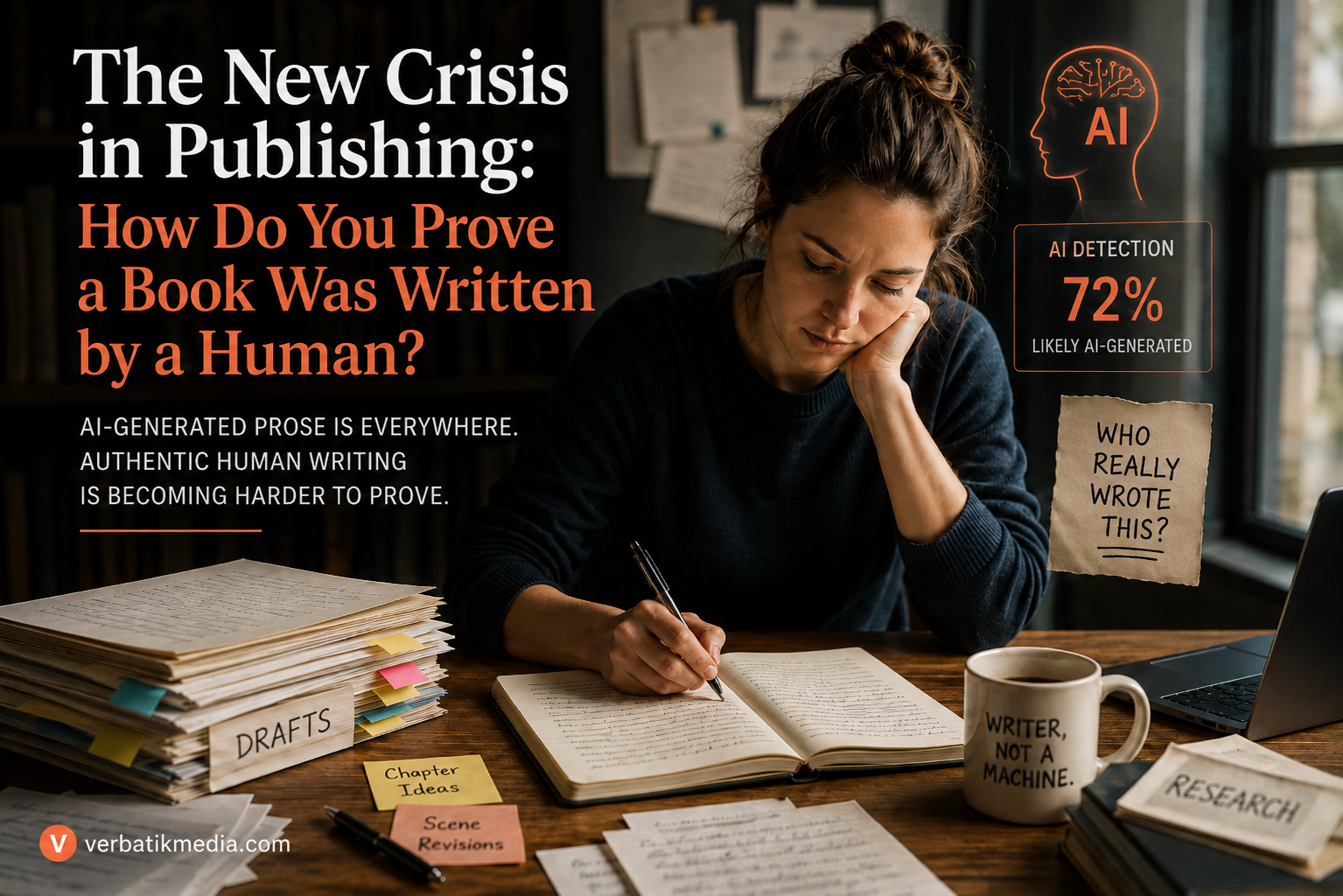
I am intentionally not going to devote half this article to it because we have recently discussed the subject at length on Verbatik Media, particularly the emerging question of how authors may eventually prove that a book was actually written by a human.
Still, AI’s presence in a serious market report tells us something.
Its effect on publishing will extend far beyond writers typing prompts into ChatGPT.
AI may influence editorial workflows, translation, metadata generation, discoverability, rights management, marketing, production, search, recommendation systems and publishing operations.
There will also be increasingly complicated questions around copyright, training data, disclosure, provenance and the commercial use of machine-generated material.
Authors therefore need technological literacy without assuming that technology removes the need for editorial judgement.
If anything, an environment capable of producing vast amounts of competent-looking content may make distinctive human voice, authority, originality and trust more valuable.
6. Indian Publishing Will Become More International — While Remaining Intensely Local
Another area highlighted by the 2026–2030 report is India’s expanding participation in the global publishing ecosystem, and its findings are expected to feed into international conversations, including the Frankfurt Book Fair 2026.
For Indian authors, this creates an interesting tension.
Publishing is becoming easier to internationalise.
A book can be sold through global digital retailers, distributed using international print networks, licensed into other territories and promoted to audiences outside India more easily than at almost any previous point in publishing history.
Yet books remain culturally specific objects.
What sells in India may not automatically sell in the UK. What works visually in one market may be packaged differently in another. Pricing differs. Genre expectations differ. Metadata differs. Reader behaviour differs. Retail infrastructure differs. Even the positioning of an author may change between territories.
Global access, therefore, should not be confused with global market fit.
The authors who handle international publishing most effectively will probably be those who understand both halves of this equation: the borderless potential of digital distribution and the very real differences between reading markets.
What Should Authors Do Now?
All of this means that writers must now need to stop entering the publishing process blindly.
Between now and 2030, I would encourage authors to:
- Think beyond a single format. Consider print, ebook, audio and future licensing possibilities where appropriate.
- Understand the rights you own and the rights you sign away. Read publishing agreements carefully and seek professional or legal advice when necessary.
- Treat Indian-language rights as an important question. Translation should follow readership potential and publishing quality rather than simply being added as a promotional gimmick.
- Plan discoverability before publication. Metadata, positioning, distribution, author visibility, ARCs, reviews and marketing should begin well before launch day.
- Make the manuscript professionally competitive first. A changing publishing industry creates new routes to readers, but none of them compensates indefinitely for an underdeveloped book. If you are uncertain where your manuscript stands, our professional manuscript-readiness checklist is a useful place to begin.
The Future of Indian Publishing Is Bigger Than “Traditional vs Self-Publishing”
This may ultimately be the most useful takeaway.
For a long time, authors have treated traditional publishing and self-publishing as the central divide in publishing.
By 2030, that distinction may matter considerably less than it once did.
A traditionally published author may simultaneously build a direct audience, sell courses, license audio rights and publish independently in another category.
A self-published author may use professional editing, international distribution, translation licensing, audiobooks and sophisticated marketing infrastructure once associated primarily with traditional houses.
Hybrid careers will become more common. Formats will overlap. Markets will overlap. Authors, publishers, platforms and readers will interact through more routes than before.
The manuscript, however, will remain at the centre of this ecosystem, because publishing ultimately has nothing worthwhile to distribute without worthwhile books.
But the journey between writing the manuscript and reaching the reader is becoming more complex, and far more interesting.
The authors who benefit most from India’s publishing growth over the next five years will probably not be those who chase every new technology or platform, they will be the ones who understand what their book is, who it is for, which rights and formats matter, how readers can discover it, and which opportunities are genuinely relevant to its long-term life.
That is the publishing literacy I believe authors will increasingly need by 2030.
Where Can You Read the India Book Market Report 2026–2030?
The India Book Market Report 2026–2030: Mapping India’s Publishing Economy: Print, Digital, Policy & Growth Pathways has been developed by the Federation of Indian Publishers in collaboration with NielsenIQ BookData and is scheduled for formal launch in New Delhi on 3 September 2026. Read the official FIP publications page and explore NielsenIQ BookData’s research and insights resources.
As of 3 September 2026, the India Book Market Report 2026–2030 has officially launched in New Delhi, published by the Federation of Indian Publishers and prepared by NielsenIQ BookData. The report carries ISBN 9788195575046 and examines the forces expected to shape Indian publishing through the end of the decade, including print and digital formats, audiobooks, Indian-language markets, artificial intelligence, copyright and licensing, distribution, policy and India’s growing international publishing presence.
Readers interested in obtaining the report should refer to the Federation of Indian Publishers’ official publications channels and NielsenIQ BookData’s research resources.
For background, you can also consult the International Publishers Association’s overview of the 2022 India Book Market Report and the Government of India’s draft National Book Promotion Policy, which reproduces market projections based on the earlier Nielsen/FIP study.

Leave a Reply