
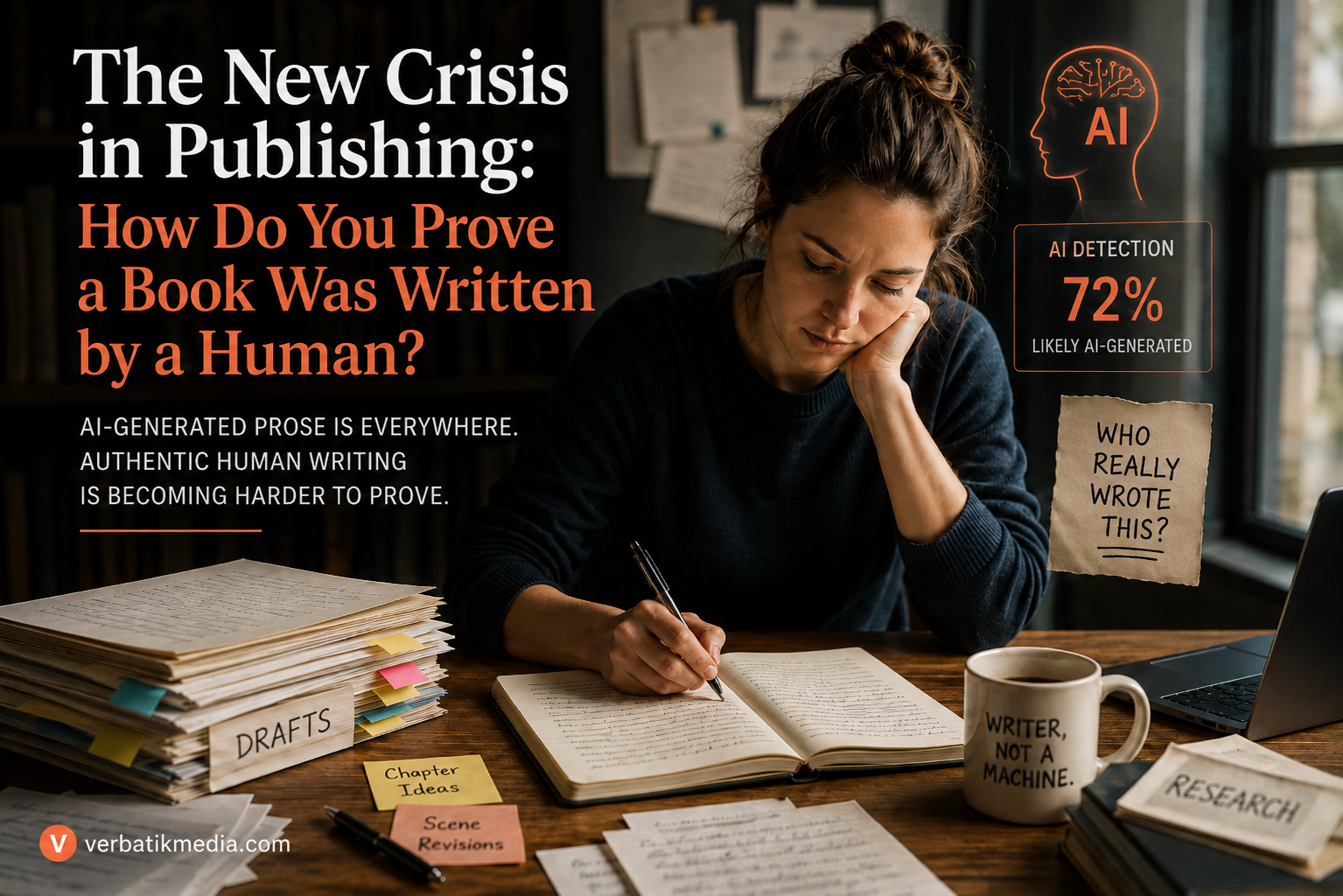
AI-Written Books Are Creating a New Publishing Problem: How Do Authors Prove They Wrote Their Own Work?
Five years ago, this would have sounded like an absurd question.
If an author handed a publisher a manuscript, authorship was one of the few things nobody particularly needed to investigate. Editors might question its quality, agents might doubt its commercial prospects, lawyers might scrutinise quotations, permissions or potentially defamatory claims, but nobody asked the writer to demonstrate that the sentences on the page had, in fact, originated inside a their mind.
This summer, Nigerian writer Jerry Adedayo Falade appeared to have achieved the sort of publishing breakthrough that most debut novelists can only fantasise about. His crime novel, Call Me, I’ll Hide the Body, attracted competitive interest on both sides of the Atlantic. According to Publishers Weekly, his agents secured six- and seven-figure deals in the UK and US respectively, while reported offers connected with screen rights climbed above $2 million.
In 2026, that assumption is becoming considerably less comfortable.
Then, on 29 July, the manuscript was withdrawn from submission after concerns arose that it might have been written using artificial intelligence.
Jerry Falade has maintained that he wrote the novel himself. His agents, meanwhile, reportedly said they could no longer substantiate that the manuscript was entirely human-written. His 2-million deal collapsed. A book that had been positioned as a major forthcoming title became, almost overnight, a case study in one of publishing’s strangest emerging problems.
The interesting question here extends well beyond one author, one manuscript or the eventual truth of one disputed case.
This obviously begs the question: what does it now mean to prove that you wrote your own book?
And this may very well become one of the defining publishing questions of the next few years.
For much of the generative-AI era, the literary world has been preoccupied with reasonably predictable questions. Will AI replace writers? Should authors use ChatGPT? Can companies train artificial-intelligence models on copyrighted books? Can AI-generated material be copyrighted? Should writers disclose their use of AI? Will marketplaces become flooded with automatically generated books?
All of those obviously still matter, but the publishing world is now encountering a second-order problem that is considerably harder to resolve. Once machines can produce prose that resembles competent human prose, how do we establish the provenance of writing?
That issue became particularly visible earlier this year when Hachette cancelled the publication of Mia Ballard’s horror novel Shy Girl amid concerns about substantial generative-AI involvement. Ballard reportedly said that her writing was original and that a friend who had helped edit the manuscript had used generative AI without her knowledge.
Whatever one concludes about that particular controversy, researcher Rachel Noorda identified the uncomfortable implication in Publishers Weekly: “When accusations of AI use and contract cancellations become more common, how will authors who haven’t used AI prove the ‘humanness’ of their writing?”
And the problem has now moved well beyond commentators and authors.
On 6 August, HarperCollins CEO Brian Murray described the current situation around AI authorship as “very murky”. More significantly, he said he did not believe AI-detection software offered a technical solution to the problem. Instead, he suggested that authors, agents and publishers may need agreed standards for establishing human authorship, perhaps even requiring writers to retain records of their writing process.
Think about what that means.
The chief executive of one of the world’s Big Five publishing groups is discussing the possibility that writers may eventually need to keep evidence of how their books came into existence.
We are moving into something new. We may now be entering the age of authorship provenance.
Authorship provenance is the documented history of how a manuscript was created, including drafts, version histories, research, editorial records and revisions that help establish the human creative process behind a book.
Why “just run it through an AI detector” is not a serious solution
The apparently obvious response is also the most dangerous one. Run the manuscript through an AI detector. Receive a percentage. Decide whether the writer is telling the truth. The difficulty is that the number displayed on an AI-detection website is not the literary equivalent of a DNA test.
In May, the Authors Guild tested five AI detectors on ten of its own articles, all published in 2022 or earlier, before the widespread public availability of generative AI. The point was simple: if the material predates the technology, a competent system ought to recognise it as human-authored.
The results were sufficiently inconsistent for the Guild to warn publishers against relying exclusively on these tools. Its broader concern was especially pertinent to professional writers: highly polished, grammatically controlled human prose may possess some of the same statistical characteristics that detection systems have learned to associate with machine-generated text.
More recent research makes the problem even harder to ignore.
A study published in August 2026 examined commercial AI detectors in an academic-integrity context. Light AI editing of otherwise human material was flagged as AI-generated at rates of 64 to 80 per cent by two detectors used in the experiment. Even unmodified contemporary human writing generated false positives. The researchers concluded that detector scores should not be treated as standalone evidence of misconduct.
The study concerns academic writing rather than book publishing, so the contexts are not identical. The underlying evidential problem, however, transfers rather neatly. A tool capable of falsely accusing a human writer cannot responsibly become publishing’s authorship tribunal.
There is another problem too: “AI use” is not a single activity. Consider the difference between these writers:
- One uses an AI-enabled spellchecker.
- Another asks a chatbot for twenty possible names for a fictional hotel.
- Another uses AI to brainstorm questions for archival research.
- Another asks it to improve the grammar of a sentence they have already written.
- Another asks it to rewrite an entire paragraph.
- Another generates scenes and then edits them.
- Another generates most of a manuscript.
Calling all seven simply “writers who used AI” is intellectually useless.
There is an enormous difference between AI assistance and AI authorship, and publishing is going to need a much more sophisticated vocabulary for distinguishing them.
I have written previously on Verbatik about using AI for writing in ways that support rather than replace the writer’s creative work, and more recently about why nonfiction writers in particular should be wary of outsourcing the actual thinking of a book to generative AI.
The distinction matters even more now because a tool may assist an author without becoming the author.
Copyright law already recognises that distinction
The legal conversation is more nuanced than much of the social-media conversation.
In its 2025 report on copyrightability and artificial intelligence, the US Copyright Office concluded that generative-AI outputs can receive copyright protection only where sufficient human-authored expressive elements are present. Merely providing prompts is not enough. At the same time, the Office explicitly confirmed that using AI as a tool within a creative process does not automatically deprive the resulting work of copyright protection.
That is a crucial distinction in my opinion.
Someone who asks a model to generate a novel and someone who uses an AI-enabled grammar tool while writing a novel are plainly not performing the same creative act.
Between those two extremes lies an increasingly complicated spectrum of human and machine involvement. And that means the important future question may be:
What did the author create, what did the machine create, and what is being represented to the reader and publisher as human creative work?
That is a much harder yet specific question. It is also a much better one.
“Human Authored” is already becoming a category
There is another development that would have seemed faintly dystopian a decade ago.
Books can now be certified as human-authored.
The Authors Guild introduced its Human Authored certification in beta in January 2025 and expanded the programme in March 2026 to authors with books published in the United States. Eligible books can carry a certification mark, and readers can search a public database to verify registered titles.
The certification permits limited uses of AI, such as certain spelling and grammar applications, while requiring the actual text of the book to have been authored by humans.
The existence of such a programme tells us something important about where the market may be moving.
For most of publishing history, “written by a human” was not a product attribute worth printing on the cover because it described virtually every book in existence.
I believe scarcity does changes value.
If synthetic books become cheap, abundant and increasingly difficult to identify on sight, then human authorship itself may acquire commercial significance.
Readers might begin choosing it deliberately. Publishers might begin marketing it. Bookshops might eventually distinguish it. Authors may begin regarding human provenance not merely as an ethical position but as part of their professional identity.
The analogy should not be pushed too far, but we already understand certification in other markets as a mechanism for signalling qualities that consumers cannot easily verify for themselves: organic production, sustainable sourcing, fair trade, protected geographical origin.
Literary provenance may eventually perform a similar signalling function. The reader cannot watch a novelist spend eighteen months drafting a book. A mark that says Human Authored makes that invisible creative history visible.
Yet certification also reveals the central difficulty: it cannot magically reconstruct how every sentence was created. The Authors Guild’s system relies on registration, identity verification, declarations and licensing terms rather than pretending that an algorithm can infallibly scan a manuscript and determine its origin.
Which brings publishing back to something surprisingly old-fashioned.
Trust.
There may be a more practical answer hiding in the way writers already work. Authors create enormous amounts of evidence while writing books. They simply do not think of it as evidence.
There are notebooks full of questions. Chapter plans that bear almost no resemblance to the eventual chapter. Research folders. Deleted scenes. Character biographies and profiles. Google searches. Photographs. Interview transcripts.
Versions called Draft 3 FINAL, Draft 3 FINAL NEW, Draft 3 FINAL ACTUALLY FINAL and, eventually, something dignified enough to send to an editor.
There are Word files with Track Changes. Google Docs histories. Comments from beta readers. Emails to agents. Queries from editors. Structural reports. Rewritten chapters. Style sheets. Fact-checking notes. Copyedits. Proof corrections.
All of this forms what I would call a creative audit trail.
No single document conclusively proves that someone conceived and wrote an entire book. Nor should writers be expected to transform their creative practice into a forensic investigation. But together, these materials can establish something an AI-detector percentage cannot: the evolution of a work through human decisions.
A first draft contains one version of a chapter. An editor identifies a motivation problem. The author changes the scene. A later version solves one problem and creates another. The ending moves. A character disappears. An argument becomes more precise. A metaphor survives twelve drafts because the author refuses to remove it despite everybody else’s objections.
That messy progression is remarkably human. And perhaps, unexpectedly, messiness is about to become valuable.
Editors may become part of authorship provenance
This is particularly interesting from an editorial perspective.
Professional editing has traditionally been discussed almost entirely in terms of quality.
An editor helps identify structural weakness, inconsistency, ambiguity, repetition, pacing problems, character gaps, logical failures, stylistic habits and sentence-level issues. A professional editorial process may also create a manuscript-specific style sheet recording decisions about spelling, punctuation, terminology, character details and consistency — something I have discussed separately in Verbatik’s guide to the hidden role of style guides and style sheets in professionally edited books.
But a serious editorial process also leaves records.
A manuscript arrives. Comments are made. Questions are asked. The author rejects some recommendations and accepts others. A second version appears. A scene is rebuilt. The editor queries it again. A third version resolves the issue differently.
None of those documents was created to prove that the writer is human. Yet collectively they document an unmistakably creative relationship between author, manuscript and editor. That could give professional editing an unexpected secondary function in an AI-saturated publishing environment.
Editorial documentation may become part of a manuscript’s provenance.
I would be extremely cautious about turning this into another reason to make authors anxious. Writers already have enough reasons to worry about whether their work is publishable, saleable, marketable, original and good.
They do not need to begin preserving screenshots of themselves typing every paragraph. But deleting every draft the moment a cleaner version exists may no longer be especially wise. Your creative history may be worth keeping to prove your work was created by you.
What should writers do now?
Probably less than the panic surrounding AI would suggest. You do not need to prove your humanity every time you open Microsoft Word. You do not need to record yourself writing. You do not need to deliberately make your prose worse so that an AI detector believes you.
And please do not begin inserting random grammatical errors into elegant sentences because some website has told you that polished prose looks “too AI”. That way madness lies.
What serious writers may want to do is much simpler.
- Keep your drafts.
- Preserve important manuscript versions.
- Retain your outlines and research.
- Do not routinely destroy Track Changes files once an edit is complete.
- Keep editorial letters and meaningful correspondence relating to revisions.
- Where your software offers version histories, do not go out of your way to erase them.
- If you use generative AI substantially, understand what your publisher, agent, competition, journal or certification programme requires you to disclose.
And most importantly, develop a clear personal boundary between using technology in your writing process and delegating authorship to technology.
The former has existed in various forms for decades. Writers use spellcheckers, dictionaries, search engines, transcription software, research databases, citation managers, grammar tools, speech-to-text systems and editorial software.
Technology mediates writing constantly. The important issue is whether the intellectual and expressive work that makes the book your work has actually been performed by you.
Perhaps the publishing industry’s answer to artificial authorship will ultimately lie not in inventing a better machine for detecting machines, but in learning to value something writers have possessed all along: a traceable history of thought, choice, revision and creation.

Leave a Reply