
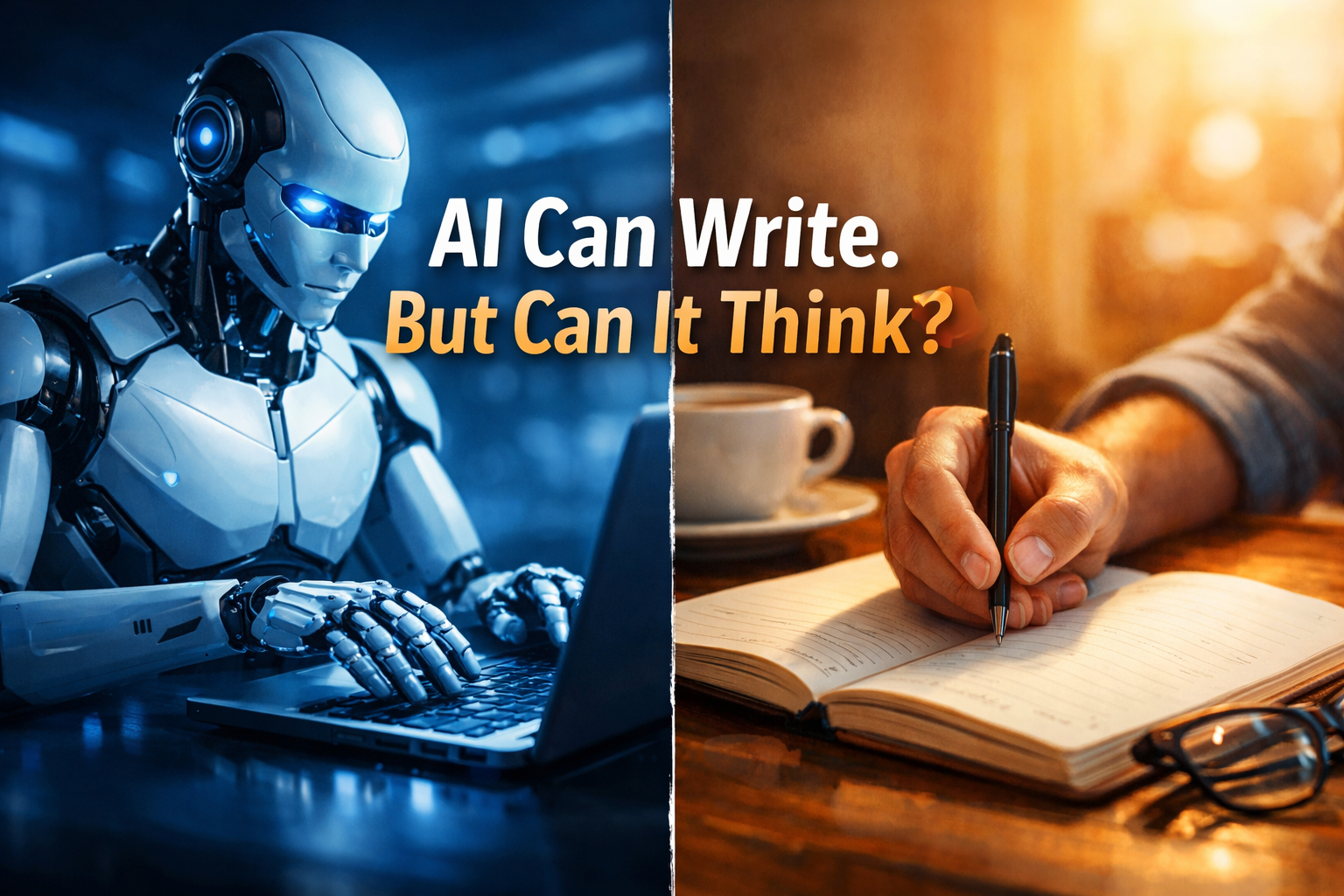
In the past year, one pattern has become increasingly difficult to ignore.
At Verbatik Media, multiple nonfiction manuscripts have been submitted for editorial review, across entirely unrelated topics, written by different authors, with no overlap in subject matter or audience.
And yet, disturbingly, they read almost the same.
Not similar in tone. Not aligned in structure. But identical in thinking. Identical in phrasing. Identical in how ideas were introduced, expanded, and concluded.
In one particular instance, two manuscripts, received weeks apart, contained not only overlapping frameworks, but near-verbatim sentences explaining completely different subjects. What should have been distinct intellectual works instead felt like variations of the same generic template.
The cause is not difficult to identify. These manuscripts were not written.
They were generated.
The Core Problem: AI Is Replacing Thinking
Nonfiction writing is not about assembling information. It is about interpreting, structuring, and communicating insight.
When writers rely on tools like ChatGPT to produce large portions of their manuscript, they are not accelerating the writing process, they are outsourcing the very thinking that gives nonfiction its value.
AI operates on probability. Nonfiction operates on perspective. And that distinction is structural which can easily be recognised by professional editors, just like it was identified by our senior editor.
AI produces:
- Predictable frameworks
- Commonly repeated explanations
- Widely circulated analogies
- Safe, generalized conclusions
A nonfiction author must produce:
- Original synthesis
- Contextual judgment
- Lived or researched insight
- Intellectual positioning
When the former replaces the latter, the result is not a book. It is a compilation.
Why This Is Especially Dangerous for Nonfiction
In fiction, AI misuse is often masked because a story can still feel “original” because the author contributes plot, characters, and emotional arcs. Even if AI assists with phrasing or expansion, there is still a creative core anchoring the narrative.
But nonfiction does not have that luxury as nonfiction is evaluated on:
- Authority
- Credibility
- Clarity of thought
- Depth of understanding
If the thinking is generic, the book collapses, no matter how polished the language appears.
This is precisely what is now being observed across submissions:
- Books that sound articulate but say nothing new
- Chapters that repeat widely known ideas without depth
- Arguments that lack internal logic because they were never truly constructed by the author
In short: it’s just the illusion of expertise without the substance of it.
The Hidden Cost: You Erase Your Own Voice
Writers often turn to AI believing it will “help them write better.” Whereas what it actually does is standardize their voice into something indistinguishable.
At Verbatik Media, one of the first markers of heavy AI dependency is this:
The manuscript reads smoothly and without any grammatical errors, but not even a single sentence feels owned or original.
There is no friction.
No tension.
No intellectual risk.
And that is precisely the problem.
Strong nonfiction writing is not perfectly smooth. It carries:
- Sharp observations
- Personal biases (when relevant)
- Unexpected connections
- A distinct rhythm of thought
AI flattens all of this into a neutral, globally acceptable tone, which is exactly why multiple manuscripts begin to sound the same.
Why “But It Saves Time” Is a Flawed Argument
Efficiency is only valuable when it preserves quality. In nonfiction writing, AI-generated drafts often create more work, not less as editors are then forced to:
- Deconstruct generic arguments
- Rebuild logical flow from scratch
- Remove repetition and filler
- Reintroduce the author’s actual perspective
In many cases, this becomes a developmental rewrite, not an edit.
What could have been a strong manuscript built gradually now requires structural rescue.
The Right Way to Use AI (If You Must Use It at All)
This is not an argument for rejecting AI entirely. It is an argument for using it correctly.
AI should function as an assistant, not an author.
Appropriate uses include:
- Brainstorming angles or subtopics
- Generating rough outlines (to be refined manually)
- Rephrasing sentences you have already written
- Identifying gaps or areas needing clarity
What it should not do:
- Write entire chapters
- Generate arguments on your behalf
- Replace your research or lived insight
- Define your voice
If the manuscript begins with AI and ends with minimal human intervention, it will inevitably read like every other AI-assisted manuscript in circulation.
A Simple Test Every Nonfiction Writer Should Apply
Before finalizing any section, ask:
Could this paragraph appear in someone else’s book without feeling out of place?
If the answer is yes, it does not belong in yours.
The Verbatik Standard: What We Look For
At Verbatik Media, nonfiction manuscripts are evaluated on one primary criterion: Does this book think for itself?
Not:
- Does it sound good
- Does it follow a structure
- Does it cover the topic
But:
- Does it offer a distinct lens?
- Does it demonstrate ownership of ideas?
- Does it justify its existence in a crowded market?
Because in today’s publishing world, clarity is no longer rare. Original thinking is.
AI is not the enemy of writers. Misuse is.
A nonfiction book is not a collection of well-phrased paragraphs, it is a position, a voice, and a body of thought that must come from the author. If that foundation is outsourced, nothing built on top of it will hold.
Tweet
And increasingly, it shows.
If you are working on a nonfiction manuscript and want an honest, professional evaluation of its structure, clarity, and originality:
Verbatik Media offers Manuscript Assessment and Developmental Editing services designed to identify exactly where your book stands, and what it needs to reach a publishable standard.
Because writing a book is not the goal. Writing one that deserves to be read is.
Leave a Reply